I have been working on 3D vision for so many years. Here are some “truths” about the sphere LED display.
First, I’d like to say something that might not be very pleasant to hear –
Most people who first consider using a sphere LED display actually don’t truly “need it”.
I’m not being pessimistic. This is the most genuine observation I’ve made over the years in this line of work.
When a client starts speaking, it usually goes like this:
“I want to create something that is very impressive and can attract a large crowd.”
Then in my mind, I would silently add:
“Did you see someone do a ball trick while watching the short videos?”
Don’t worry, I completely understand. Because when I first saw those spherical LED lights, I almost made a purchase right there and then (if I had the budget).
But calm down and you will realize – this thing is cool, but it’s not simple.
So today, I won’t beat around the bush. Let’s just say that we’re both sitting in a bar, and I’ll spill all my real experiences about the sphere LED display to you.
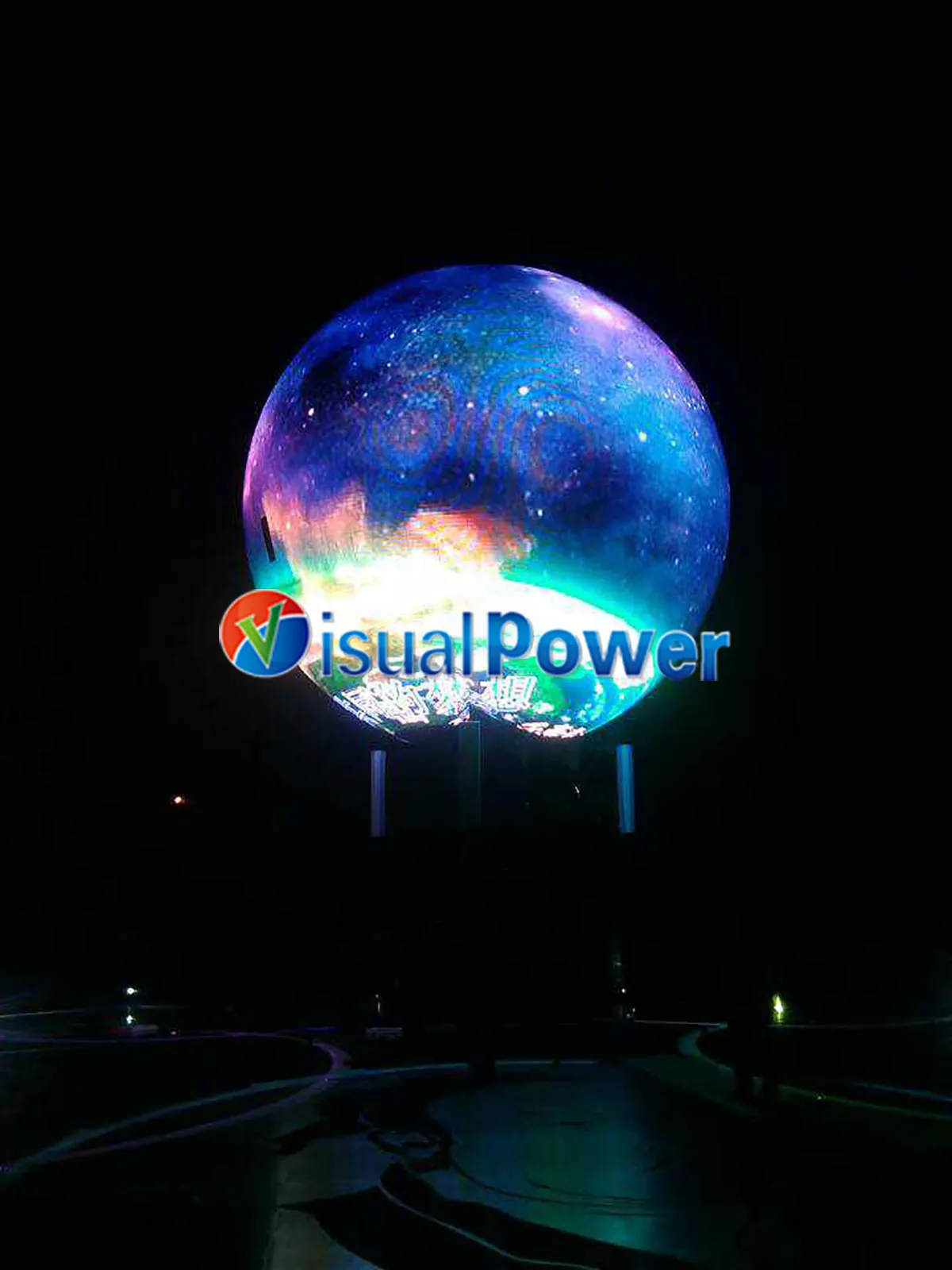
Let me make the most important point clear: What you bought is not a screen, but a “trouble body”.
Really.
You thought you were buying a display device, but in fact you were purchasing:
- A customized structure
- A complex control system
- A bunch of modules that might have problems in the future
- And a long-term maintenance responsibility
I have witnessed too many projects. They were all very spectacular in the early stage, and their opening day was featured on everyone’s social media feeds.
Three months later – there was a complete black screen. Six months later – hardly anyone was watching anymore.
The problem is not with the equipment itself; it’s that no one has considered how it can “survive”.
I fell into the most costly pit: The content budget was grossly underestimated.
You might think that money should be spent on hardware, right?
Wrong.
If you allocate 80% of your budget to the sphere LED display itself, but the content is just “randomly produced”, the final result will be extremely embarrassing.
I have witnessed a case (without naming the specific one). The hardware was beautifully designed and the ball was quite large, but what was the content?
- Rotating the enterprise logo
- Several ordinary promotional videos
- Some flat animations directly pasted on
As a result, the audience just looked at it for a moment and then left.
The ball was still spinning there, but nobody cared.
At that moment, I really wanted to say:
You’re not using the ball, you’re just wasting it.
Now when I’m working on a project, I will simply say one sentence to the client:
“If you don’t intend to do the content seriously, then you don’t need the ball.”
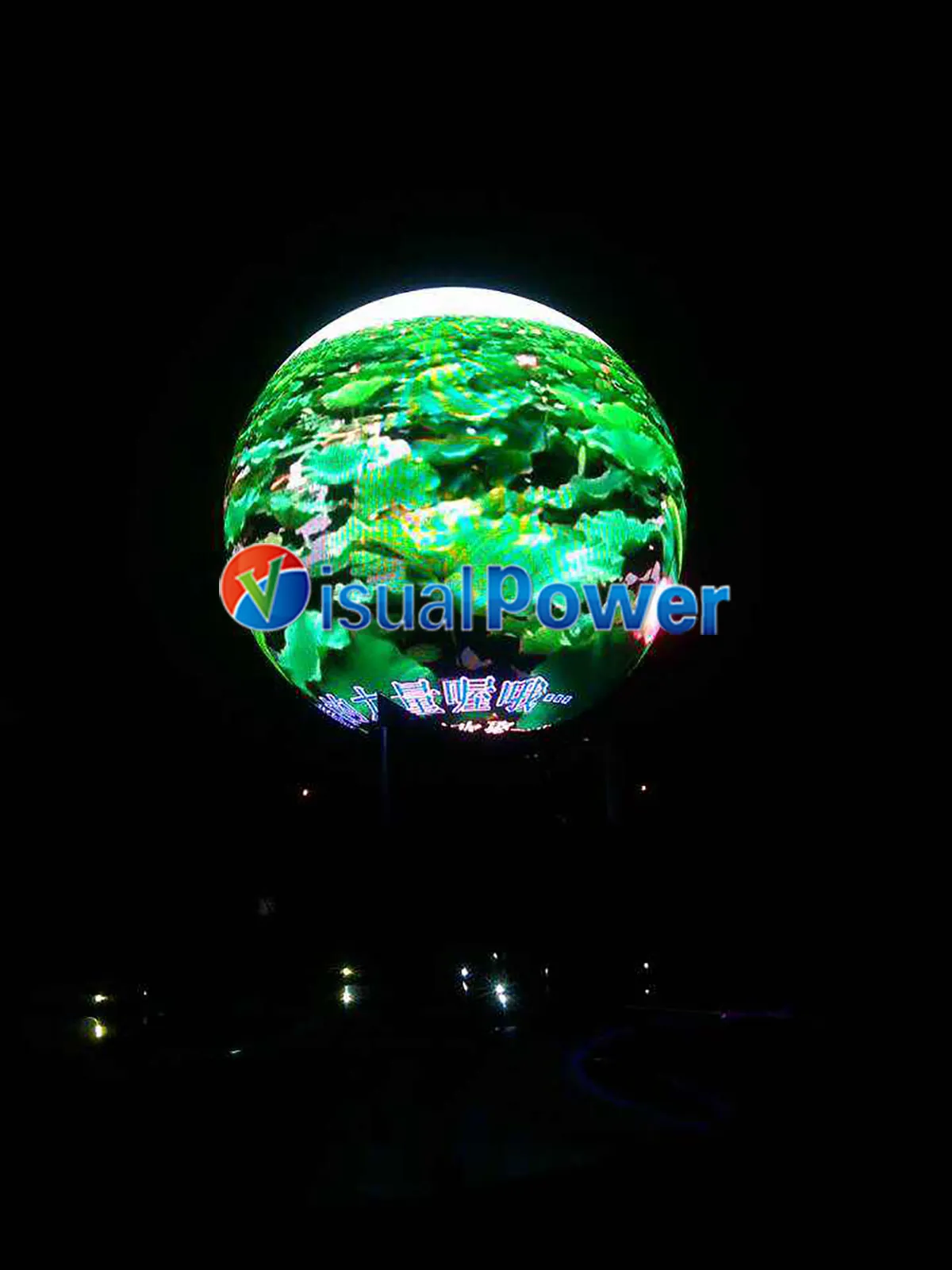
Regarding the resolution, I suggest you be a little more calm.
This topic is truly classic.
Customer: I want the clearest one.
Me: How much is your budget?
Customer: … Let’s start by discussing how clear it can be.
I have laughed countless times.
The sphere LED display is different from your home TV. It’s not something you sit on the sofa to watch. It’s a spatial installation.
What you need to consider is:
- How far away are the audience?
- Will they move?
- Is the content detail-oriented or atmosphere-oriented?
Once we were working on a project for a shopping mall atrium, the client insisted on using high-density pixels.
What was the final result? From a distance, it looked great; up close, it was even better – but the problem was, no one would get close to look at it.
The money was spent, but the experience didn’t improve much.
So my current suggestion is quite simple:
Save the money and invest it in the content and structure. The return will be higher.
Installation and structure: This is the part that is most prone to mistakes, and the mistakes are quite serious.
I’ll tell you a true story.
There is a project involving the construction of a suspended sphere. The design drawing is very beautiful.
When it was installed on site – the sphere was shaking slightly.
Do you know what that feels like?
It’s like a huge LED balloon, slowly “breathing” there.
At first, everyone thought it was quite artistic.
The next day, the client asked me, “Is this safe?”
At that moment, I thought to myself: It’s just art, so don’t let it fall.
The root cause of the problem is actually quite basic:
- The weight distribution was not calculated in detail.
- The supporting structure carried risks.
- The installation and leveling were not done properly.
For a sphere, errors tend to be magnified. Even a small deviation will appear as a “problem” to the naked eye.
There is another point that many people overlook – heat dissipation.
A sphere does not have as good heat dissipation as a flat screen. If the internal design is not good:
- The brightness will gradually decrease.
- The color will be unstable.
- The service life will be directly reduced.
These things are usually not clearly stated in the quotation, but you will eventually come to realize it.
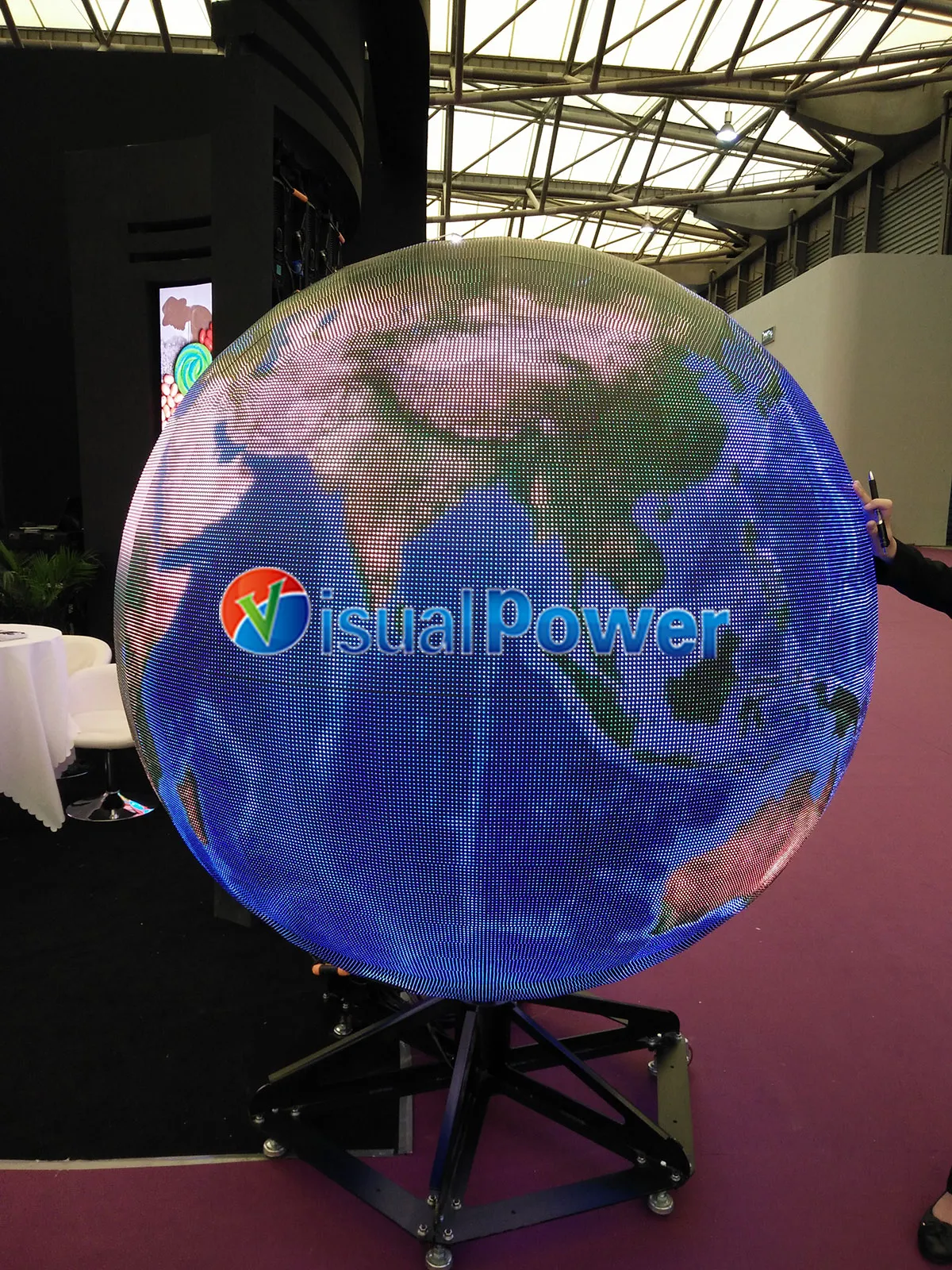
Why are some solutions used repeatedly in the industry?
I don’t really like the term “recommended brands”, but I can talk about an industry phenomenon.
After you have been doing this for a while, you will notice that certain supplier names keep recurring. It’s not because they are the cheapest, but because – they are less likely to have problems.
I previously worked on a project that utilized the sphere LED display solution from Visualpower.
My feeling at that time was quite simple:
It didn’t give me any trouble.
This statement may seem ordinary, but in this industry, it is actually quite rare.
Specifically:
- The assembly is quite neat. There is no need for extensive post-processing to fix the content.
- The control system has decent support for spherical content.
- It runs stably for a long time without any strange minor issues.
You might think these are “basic requirements”, but trust me – many projects fail to even meet the “basic” standards.
Not all spaces require a ball. You must remember this.
The most unsuccessful project I have ever witnessed was when a very clean space was forcibly fitted into a sphere-shaped LED display.
So, what’s the result?
- The space is compressed and chaotic.
- The flow of movement is disrupted.
- The ball becomes an “unnecessary presence”.
The correct way to turn on a spherical LED is to make it the “focus” rather than an “obstacle”.
The places that are suitable for it usually have the following characteristics:
- The space is spacious enough.
- A visual center is needed.
- People will linger instead of passing through quickly.
For example:
- Shopping mall atrium
- Exhibition hall entrance
- Technology experience space
If your scenario is:
- Focus on information display
- Audience stays for a short time
- Budget is limited
Then I would simply say this:
You might be better off with a regular LED screen.
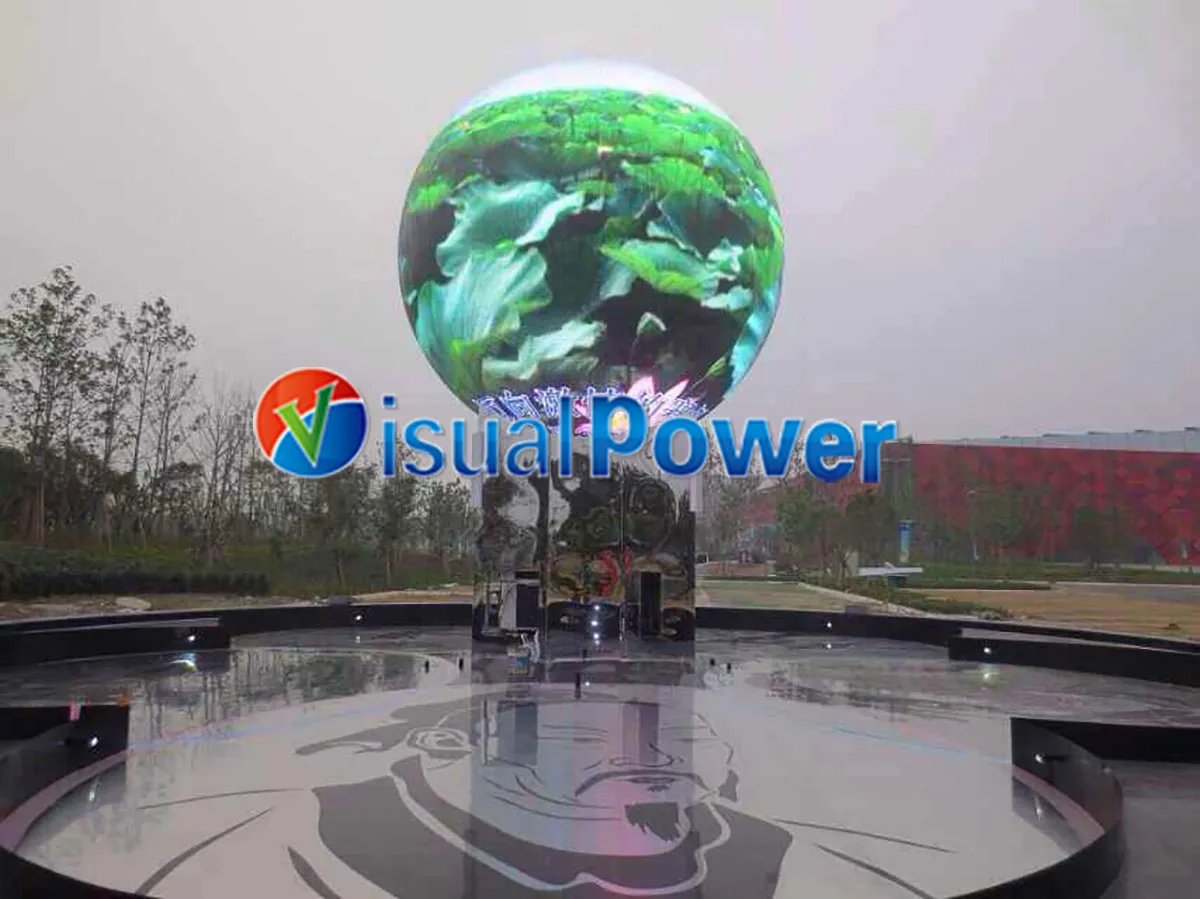
From the perspective of a designer, the aspect I value most is: Does it have a “lively feeling”?
This might be a bit abstract, but I’ll try to explain it in plain language.
A good sphere LED display is not constantly “displaying content”.
It should be like something that is breathing.
I worked on a project where the sphere was designed to resemble a “data heart”:
- When people approach, the heartbeats quicken.
- When people move away, the rhythm slows down.
- The colors flow like blood.
The scene effect was quite interesting –
People wouldn’t just “glance at it”, but would stop and even circle around it.
That feeling is not “Wow, it’s so clear”, but rather:
“This thing is kind of interesting.”
And this is precisely the effect you truly desire.
If you really decide to go ahead, I’ll give you these few very practical suggestions.
No empty talk, straight to the point.
1.Don’t ask about the price first; ask about the purpose instead.
Why do you want it? To attract customers? To create a brand memory point? Or just because it’s “attractive”?
The purpose is unclear. All of this is in vain.
2. The content team should get involved in advance.
Don’t wait until the equipment is installed before thinking about the content. By then, you’ll basically only be able to “make do”.
3. Set aside maintenance budget
The spherical LED doesn’t stop working once it’s installed; it needs to be maintained.
4. Don’t blindly believe in parameters
Brightness, resolution and refresh rate are all important, but they are not the decisive factors.
5. Select a team where you don’t feel exhausted when communicating with them.
This is even more important than the technology. Because of this project, there will definitely be many details that need to be refined repeatedly.
The last sentence was truly spoken to you like a friend would do.
If all you want is a “device that looks impressive”,
the sphere LED display might not be the best choice.
But if you want to create something that —
causes people to stop, look up, and even take out their phones to take a photo of it,
Then it is worth it.
Just make sure you are prepared:
It won’t make things easier for you; instead, it will force you to do every detail perfectly.
But once you get it right –
That on-site effect will make you feel that you didn’t waste your money.
If one day you actually create a sculpture,
I hope it won’t be “just another LED installation”,
but something – something that will be remembered.



 The LED Displays Everyone’s Asking About in 2026 (And Where They Work Best)
 Hexagon LED Display: How Geometric Screens Are Transforming Modern Exhibitions
 Difference of SMD GOB HOB COB LED display module
 Why Museums Are Turning to Fine Pitch LED Displays for Better Visitor Engagement

 Sales Manager